
Gray County Release Date Meanings
Texas uses several date labels, and they cannot be collapsed into one promise. The TDCJ definitions call a projected release date the date calculated by Classification and Records for an expected prison exit if parole does not occur sooner. The formula depends on the offense, offense date, sentence, eligibility rules, and current credits. Discharge describes the end of the correctional sentence or supervision status.
The official definitions page shows those terms:
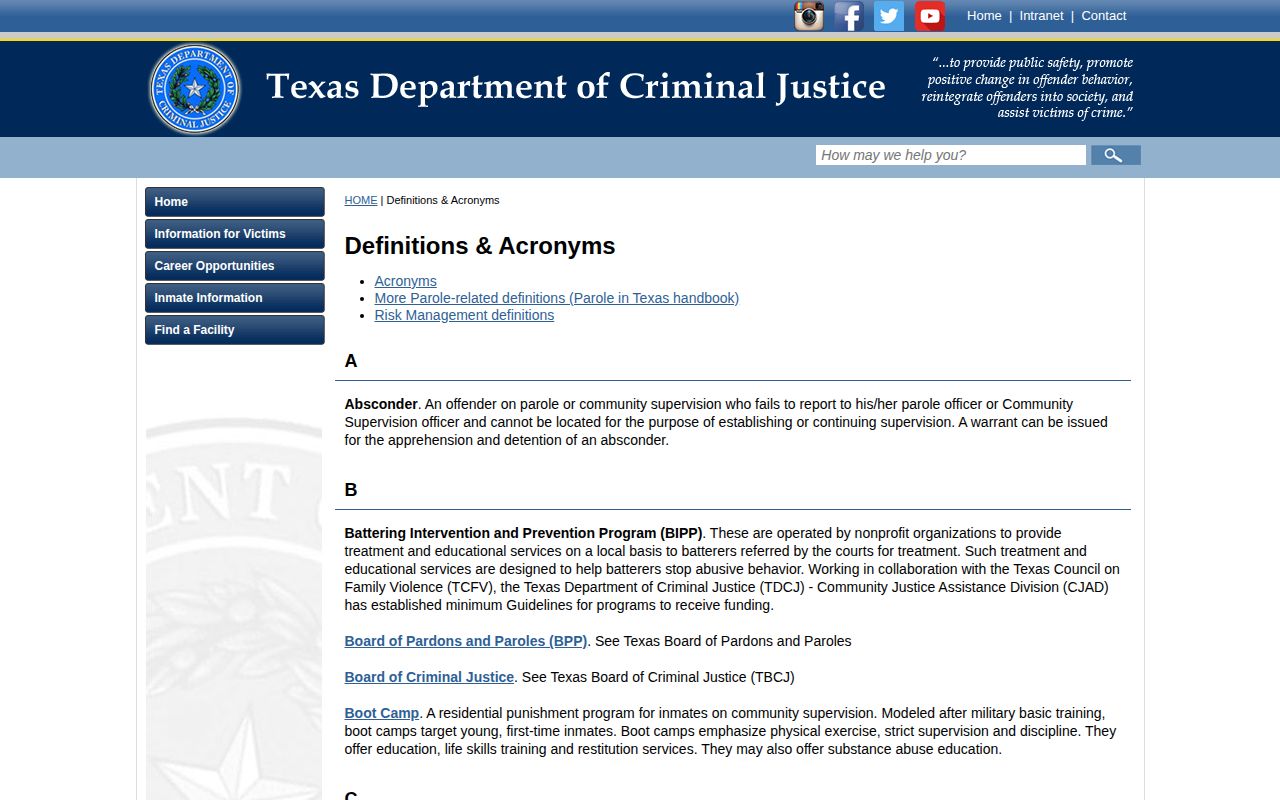
The source language should stay attached to the date. A projection is not an actual gate-out event.
| Date | What it means |
|---|---|
| Parole eligibility | The earliest statutory point for consideration, not a release order |
| Projected release | TDCJ's current calculated prison exit if parole does not occur sooner |
| Scheduled release | An operational date set after favorable action and release-certificate audit |
| Maximum expiration | The sentence completion point when earlier supervised release does not occur |
| Actual release | The completed event shown by a book-out, discharge, or release record |
A scheduled date may change, even on release day. Confirm a completed Gray County release with the office that held the person.
Find Gray County Projected Dates
Begin with the facility. Gray County Jail is a Sheriff's Office site. Rufe Jordan Unit and Baten Intermediate Sanction Facility are TDCJ sites. The same Pampa location does not make their calculations interchangeable. A person transferred out of the county jail should be followed into the receiving system shown in the release record.
- Identify the last confirmed facility and gather the full name, date of birth, booking number, SID number, or seven-digit TDCJ number.
- For current TDCJ custody, use the official inmate search and compare identity, unit, offense, and sentence data.
- Request projected-date information through TDCJ email when a web result is unclear, or call the proper general, pre-vote, or post-vote line.
- For a Gray County jail sentence, obtain the judgment, jail-time credit, commitment, and the jail's calculation.
- For a pretrial case, review bond and court orders. Do not create a sentence release date where none exists.
- Recheck near the expected event and obtain the completed release or discharge record afterward.
The full local verification chain, including book-out and court records, is available through the Gray County released inmate search. That chain matters when a projected date passes but another hold or transfer remains.
Gray County TDCJ Search Limits
The TDCJ Inmate Search includes only people currently incarcerated in a TDCJ facility. It updates on working days and says the information is at least 24 hours old. Search by last name and first initial, or use a TDCJ or SID number. Optional gender and race fields can narrow a common-name search. The interface has no inmate photograph.
The official current-inmate screen displays both its fields and timing warning:
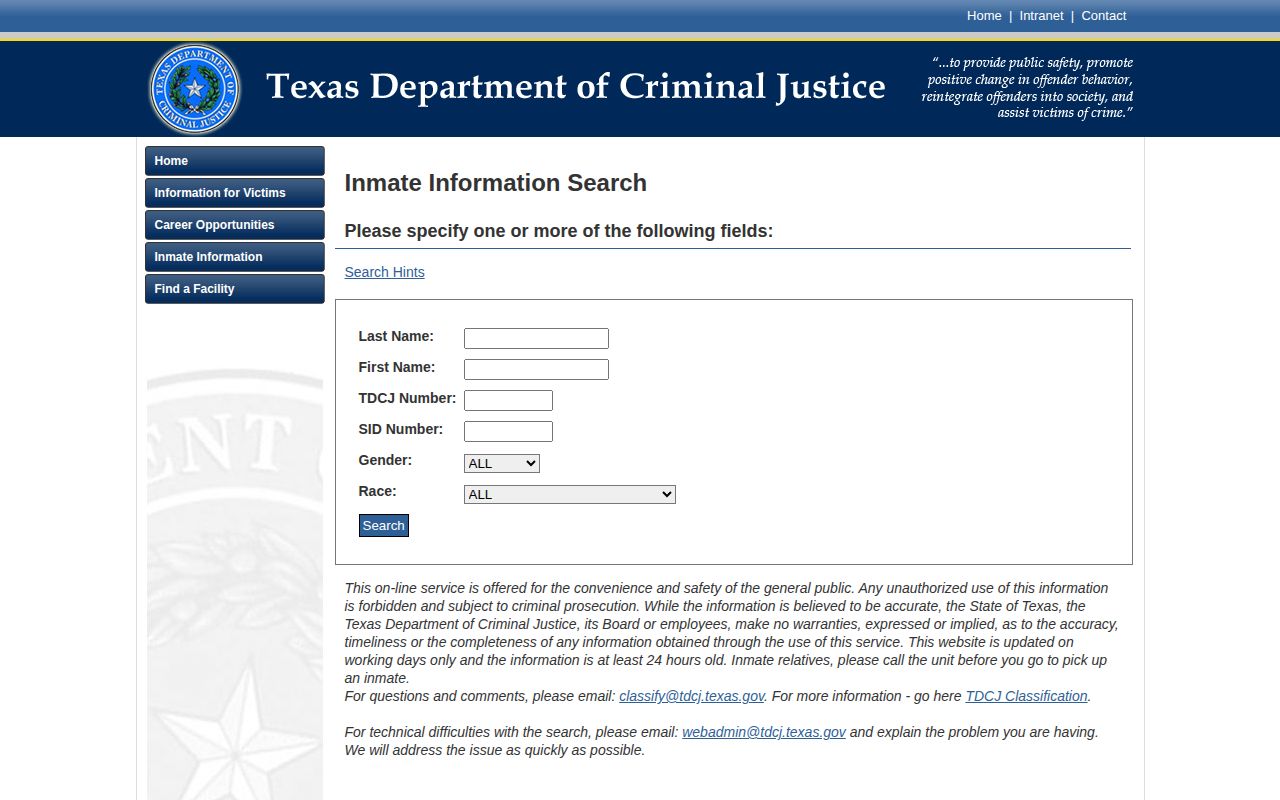
A missing former Jordan or Baten inmate is expected under that scope. Disappearance does not prove the date or type of release.
While a person is current, the record may show location and sentence calculation data. Compare the unit code because Jordan is JN and Baten is NJ. A future projected date supports planning. It does not establish that a release certificate has been audited or that every hold has cleared.
Note: TDCJ's 24-hour information warning applies to the state search, not to Gray County Jail or a local recent-release feed.
Request Gray County TDCJ Dates
The TDCJ information-by-email channel can supply a TDCJ number, location, offense, prior incarceration history, current incarceration details, and projected release date without charge. Send the full name with the TDCJ number or exact date of birth. Approximate age and county of conviction can help when exact identifiers are not known. TDCJ expressly excludes photographs and Social Security numbers.
The official request page shows the available fields and identifier rules:
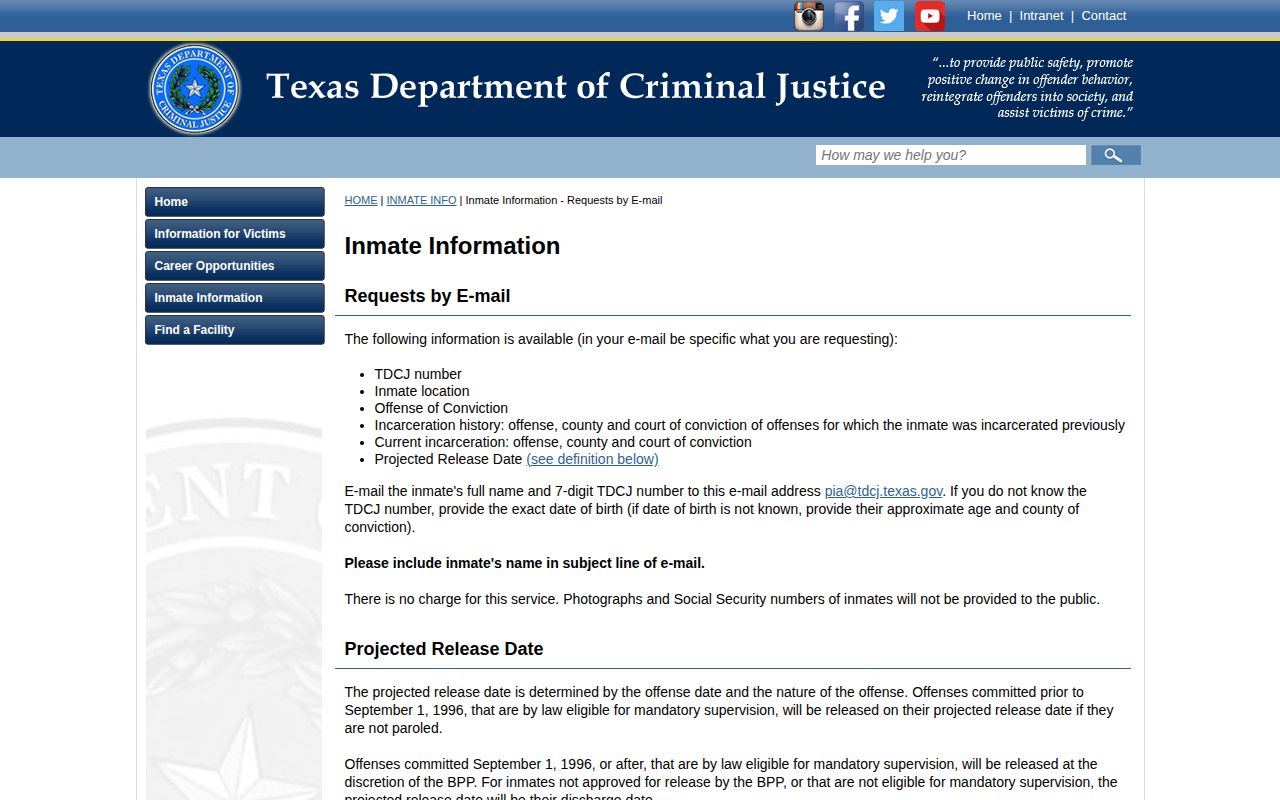
This route is useful when a name search is ambiguous or when a prior TDCJ episode needs explanation.
Telephone routing depends on the stage. General and locator information is available at 936-295-6371 or 800-535-0283, Monday through Friday from 8:00 a.m. to 5:00 p.m. Before a Board vote, use 844-512-0461. After a favorable vote, Parole Division release status is 512-406-5202. Have the TDCJ number, SID number, or date of birth ready.
The TDCJ parole FAQ distinguishes a projection from a scheduled release. The scheduled date and release location are set after a certificate audit, and both can change without notice. A phone answer should be preserved with the date, office, identifiers used, and exact status terms.
Gray County Good-Time Rules
Government Code Chapter 498 governs TDCJ good-conduct time. Section 498.003 sets classifications and accrual rules. Some classes can earn stated credits for time served, while Class III earns none. Other statutory credits may apply. Yet the core rule is simple: good time is a privilege that affects parole or mandatory-supervision eligibility. It does not reduce the sentence imposed by the court.
Never subtract a credit rate from a sentence on a calendar. TDCJ Classification and Records must use the offense title, offense date, calendar time, valid credits, disciplinary history, mandatory-supervision eligibility, Board action, judgment, jail credits, detainers, and later sentence changes. Missing or corrected court data can alter the result after intake.
Government Code Chapter 508 adds the parole and mandatory-supervision framework. Section 508.147 generally addresses cases in which calendar time plus accrued good time reaches the sentence, subject to eligibility and decision rules. Section 508.149 lists exclusions and discretionary review. Rules differ for offenses committed before and after September 1, 1996.
- Calendar time
- Actual days served.
- Good-conduct time
- Statutory credit that can affect eligibility but does not erase the sentence.
- Detainer
- A notice that another authority may seek custody or hold the person.
- Flat time
- Actual calendar time without adding good-time credit.
Note: Only TDCJ's current calculation or the controlling county judgment and jail calculation should be used for a named person's date.
No Gray County 85% Rule
Texas has no universal rule requiring every prisoner to serve 85 percent of a sentence. For offenses covered by Section 508.145(d), eligibility generally uses actual calendar time without good time equal to half the sentence or 30 calendar years, whichever is less, with a minimum calendar component. Other subsections, offense dates, enhancements, and exclusions differ.
The safe route is to identify the exact offense, judgment, offense date, sentence structure, and governing subsection. Parole eligibility is only a point at which consideration may occur. It does not compel a favorable vote or set the actual release day. Likewise, mandatory-supervision eligibility can still require a decision under the applicable law.
Gray County dates should never be estimated from a percentage found in a general search. Obtain TDCJ's calculation for Jordan or Baten custody. For a local sentence, obtain the court judgment and Gray County Jail calculation.
Gray County Date Change Factors
A projected date changes when one of its inputs or release decisions changes. Some updates move it earlier. Others move it later. The public display may also lag the underlying action, so date changes should be checked through the office responsible for that stage.
| Change | Possible effect | Best confirmation |
|---|---|---|
| Corrected judgment or jail credit | Recalculates time credited or sentence data | Court order and TDCJ audit |
| Good-time gain or forfeiture | Changes eligible calculations where law permits | TDCJ Classification and Records |
| New or consecutive sentence | Adds or restructures time | Judgment and sentence record |
| Parole Board action | May create, move, deny, or condition a release path | Board status and release-status line |
| Detainer or hold | May lead to transfer or block community release | Custody holder and receiving agency |
| Release-certificate audit | Sets or changes the scheduled date and location | Parole Division release status |
When the event date arrives, ask whether the person actually departed, stayed pending a hold, or transferred. “Released by TDCJ” and “released to the community” may differ if another authority takes custody.
Gray County Jail Date Calculations
TDCJ's prison formula does not control a sentence served at Gray County Jail. The local calculation depends on the sentencing judgment, jail-time credit, commitment, concurrent or consecutive terms, and any lawful county policy. No official Gray County good-time or weekend-release policy was found, so no local rate or release-day adjustment should be promised.
Call Gray County Jail at 806-669-8022 and ask which existing record states the calculation. Request the judgment, credited days, commitment, book-in date, expected completion date if maintained, and the actual book-out field after release. The relevant Gray County court can confirm the order and later changes. A court order may explain why release should occur, while the jail record gives the physical time out.
A pretrial detainee has no sentence-completion date. Bond, dismissal, court order, or case resolution may end custody, but another hold can prevent release. Ask for the full disposition and destination instead of forcing a projected date into that episode.
Jordan and Baten Release Paths
Gray County contains two co-located state facilities with different roles. A person leaving Rufe Jordan Unit may parole, enter mandatory supervision, directly discharge, or transfer. A person leaving Baten Intermediate Sanction Facility may return to supervision, move to another correctional placement, or leave under another authorized disposition.
Neither event belongs in the Gray County Jail roster path merely because both facilities have Pampa addresses. Preserve the JN or NJ unit code, use TDCJ release-status channels, and contact the Amarillo District Parole Office when supervision follows. Baten departure should not be labeled sentence completion unless TDCJ actually records a discharge.
For a future event, the Texas IVSS release-alert process can provide notification through the correct county or TDCJ portal. Treat the message as a signal. Confirm the completed date, status, and destination with TDCJ afterward.
Two records give the clearest result: TDCJ's release or discharge confirmation and the parole, court, or receiving-agency record that explains what followed.