
Rufe Jordan Release Outcomes
Rufe Jordan Unit is operated by the Texas Department of Criminal Justice, or TDCJ. It is not part of Gray County Jail. A person leaving Jordan may transfer to another TDCJ unit, enter parole, enter mandatory supervision, or directly discharge. Parole is conditional release after a Board decision. Mandatory supervision is a statutory form of supervised release for an eligible person. Direct discharge means the sentence ends without parole supervision on that sentence.
Those labels matter. A transfer is continued confinement, not a community release. Parole and mandatory supervision end prison confinement but keep the person under stated conditions. Direct discharge is different from either supervised status, though another case or detainer could still affect what follows. Ask TDCJ to identify the precise disposition and effective date rather than describing every Jordan departure simply as release.
Confirm a Rufe Jordan Release
Start with the TDCJ Inmate Search when current state custody is plausible. Search by TDCJ number or SID number when available; otherwise use the last name and at least a first initial, with optional identifying fields. TDCJ says the public data updates on working days, is at least 24 hours old, covers current inmates, and contains no photographs. A missing former inmate is therefore expected and does not prove the release date or destination.
- Verify the person’s TDCJ or SID number and Jordan unit code JN.
- Check the current locator for present custody or a transfer.
- Use TDCJ telephone or email information when the web record is absent or historical.
- For a post-vote release, call Parole Division release status at 512-406-5202.
- If supervision follows in Gray County, contact Amarillo District Parole Office.
The Gray County release-search guide separates these state records from Sheriff book-out records. Gray County Jail has no authority over a Jordan release merely because both facilities are in the same county.
Rufe Jordan Records Contact
Rufe Jordan Unit (JN)
1992 Helton Road
Pampa, TX 79065
806-665-7070
Use the unit for facility-specific direction and TDCJ central channels for offender information. TDCJ’s general locator numbers are 936-295-6371 and 800-535-0283, Monday through Friday, 8 a.m. to 5 p.m. The official email-information process asks for a full name with the seven-digit TDCJ number or exact date of birth; approximate age and county of conviction can help. Available information may include the TDCJ number, location, offense, prior incarceration history, current incarceration facts, and a projected release date. TDCJ says this information is supplied without charge and photographs are not provided.
For a written inquiry, preserve the full name, TDCJ number, SID number, date of birth, county of conviction, Jordan’s JN code, and the date range at issue. Ask whether the event was transfer, parole, mandatory supervision, or discharge. That wording prevents a broad request from returning only current location data.
Inside Rufe Jordan Unit
The official Jordan directory identifies a men’s prison about seven miles east of Pampa and north of Highway 60. TDCJ lists an October 1992 opening, an official capacity of 1,152, and G1, G2, G4, transient, and parole-offender custody levels. These are prison classifications, not county-jail booking categories.
Jordan also lists CHANGES and pre-release programming. Program participation can support preparation, but it is not itself a release order or a fixed release date. The legal and records path still runs through TDCJ classification, records, the Board when parole is involved, and Parole Division for the operational release. A directory description should never be used to infer an individual outcome.
The successful official Jordan source image shows the unit facts and pre-release programming described by TDCJ.
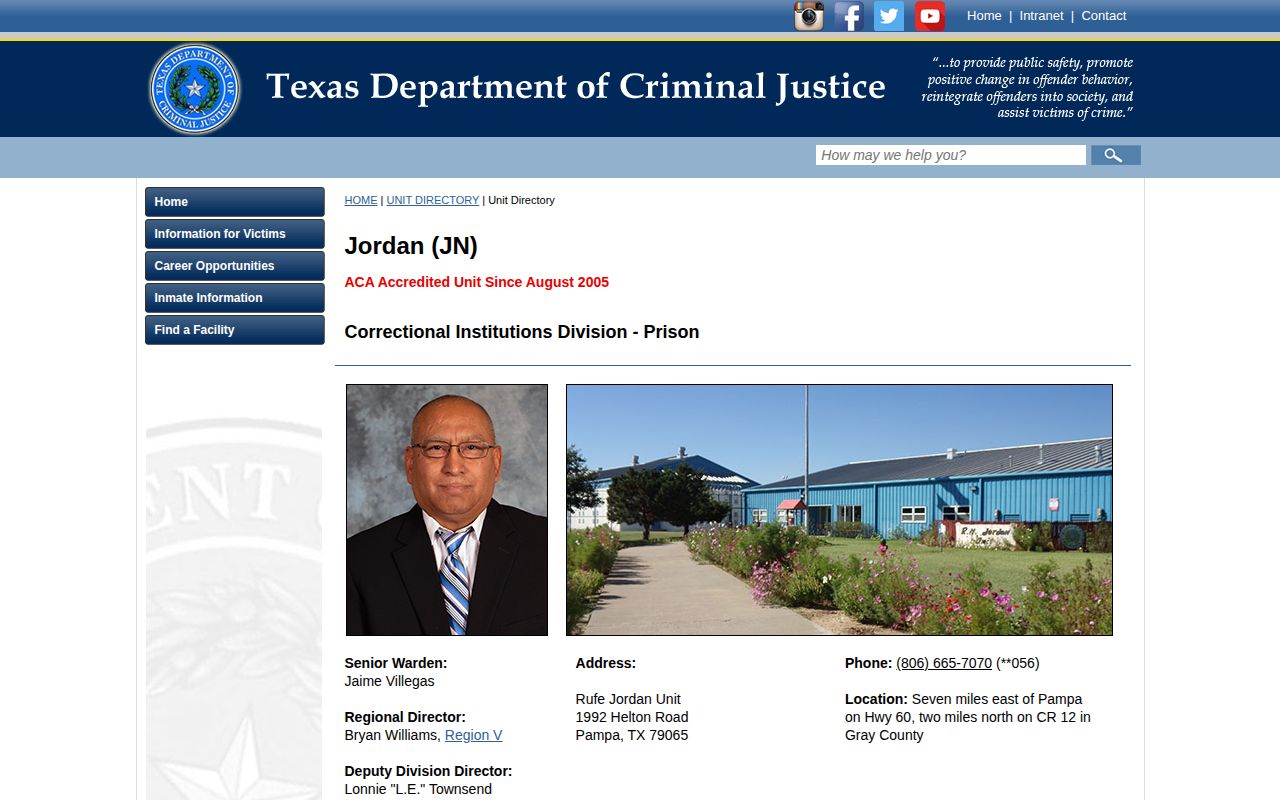
The unit page establishes Jordan’s role and contact, while person-specific release confirmation still requires the offender and release-status channels.
Jordan Projected Release Dates
A projected release date is a current calculation, not a promise. TDCJ Classification and Records accounts for the sentence, offense date, calendar time, applicable good-conduct time, mandatory-supervision eligibility, Board action, detainers, and later sentence changes. A court judgment and jail credits must be received and audited. Corrections to that material, disciplinary forfeiture, a new sentence, or Board action can move the date.
Keep four concepts separate: parole eligibility is the first point for consideration; projected release is TDCJ’s calculated exit under applicable rules; scheduled release is an operational date after favorable action and audit; maximum expiration or direct discharge is the sentence completion point. Texas has no universal 85-percent rule. The projected release date guide explains why subtracting good time from a sentence produces unreliable answers.
Jordan Parole Follow-Up
Texas Board of Pardons and Paroles decides parole. TDCJ Parole Division supervises people after release. The ordinary review does not use a public formal hearing or case calendar; panel members review and vote files. Before a vote, the official status number is 844-512-0461. After a favorable vote, release-status questions go to 512-406-5202 with the TDCJ or SID number and date of birth.
Gray County is assigned to Amarillo District Parole Office at 5809 S. Western Street, Suite 120, Amarillo, TX 79110, telephone 806-355-9218. The Amarillo Board Office occupies Suite 200 and handles a different role. The district office can help with supervision after release but cannot change a Board vote. A parole certificate and supervision record complement the TDCJ departure record.
Jordan Transfers and Detainers
If the locator moves from Jordan to another unit, that is a transfer within custody. Follow the new unit and preserve both entries. If TDCJ reports release to another authority, ask for that authority and destination. A detainer is a request or legal hold from another agency. It can cause someone to move directly from TDCJ custody into county, federal, or immigration custody.
A BOP locator result belongs only to federal prison custody, and ICE has its own detainee locator. Neither route should be searched without a factual reason to suspect that transfer. The most useful confirmation is a two-record chain: TDCJ’s disposition and the receiving authority’s admission or status.
Jordan and the Old Jail
The prison should not be blended with the jail once housed in Gray County’s 1928 courthouse. A Texas Historical Commission nomination says completion of a county jail in 1992 allowed conversion of the courthouse’s old fourth-floor jail, which had six six-person compartments. Jordan also opened in 1992, but the matching year does not make the facilities the same project or record system.
Current Jordan information comes from TDCJ. Current local-jail information comes from the Sheriff. Historical courthouse documents are valuable context, yet they cannot establish where a modern TDCJ inmate went or whether a state sentence discharged.
Jordan and Baten Departures
Jordan and Baten share a Pampa-area complex and telephone, but their functions differ. Jordan is a prison. Baten is an intermediate-sanction facility tied to supervision responses. Leaving Jordan may reflect parole, mandatory supervision, direct discharge, or transfer. Leaving Baten may instead mean return to supervision or another correctional placement.
Keep the unit code in every inquiry: JN for Jordan and NJ for Baten. Shared geography does not create one combined release record. If the name is uncertain, ask TDCJ to identify the unit tied to the person and date before drawing a conclusion.